
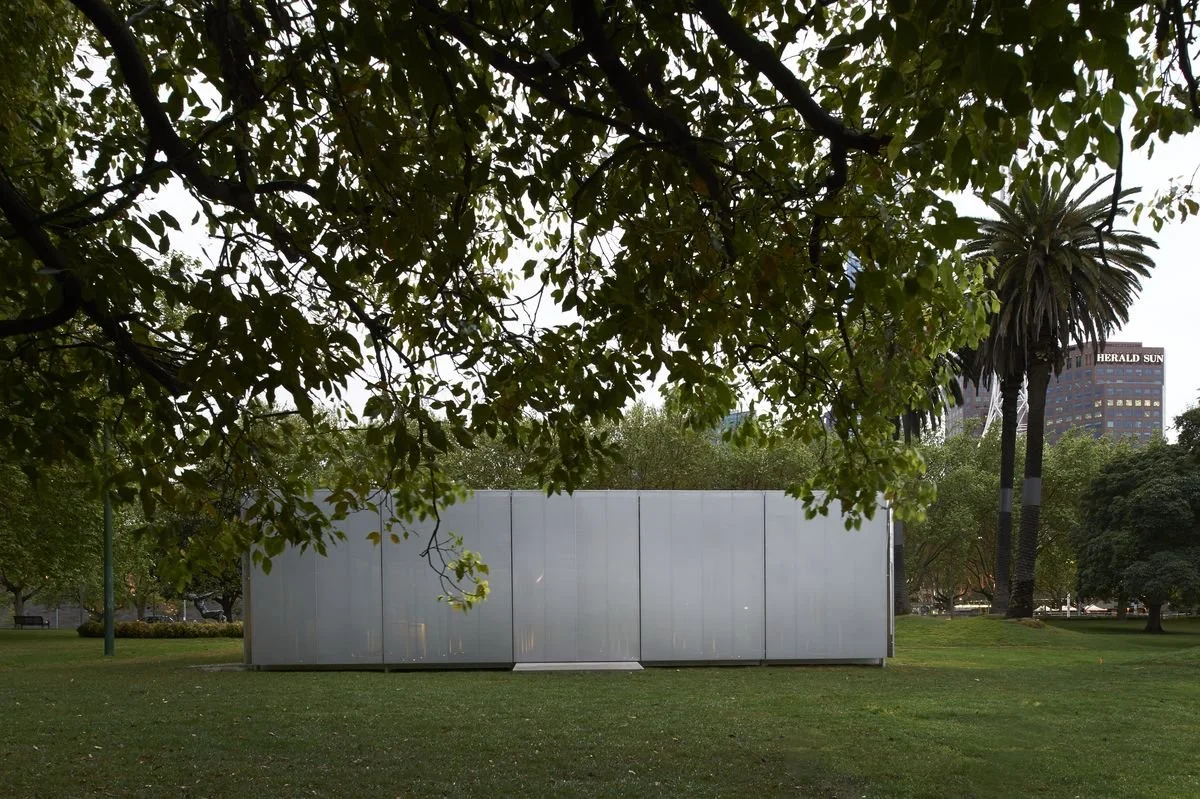
Sean Godsell Architecture recently announced that the 2014 MPavilion is going to be demolished (or dare I say, deconstructed). So where should it go? Can we repurpose it differently?
The MPavilion initiative was one that I always looked forward to during my architectural school years. First unveiled during the second semester of 2014, the pavilion was sparked a mere curiosity and perhaps the start for the search of my own architecture identity. It would only be when attending the opening day that would catalyse an ongoing fascination for the initiative itself.
When Sean Godsell’s pavilion first entered our archisphere – there was a form of expectation around it. Myself was clueless as ever as to what the structure was – for I was too distracted by the anticipation of my classmate’s participation in the contest. It would only be when the contest commenced, and witnessing the grand opening of Godsell’s pavilion’s automated fins that called for attention to the design itself.
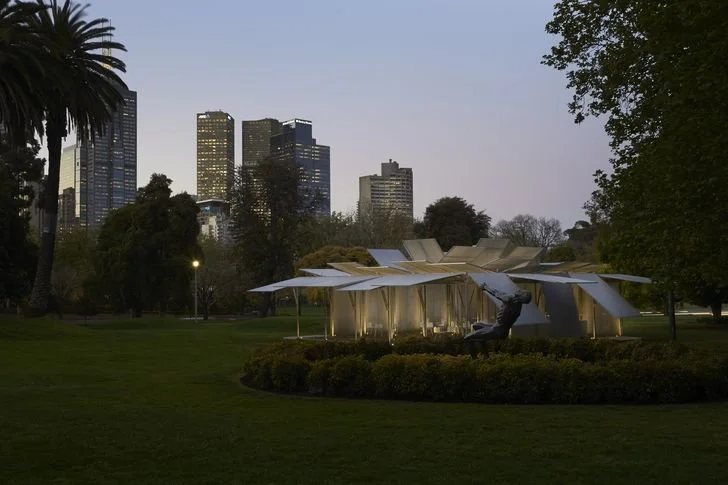
Nestled within Queen Victoria gardens across the NGV – MPavilion presents an alluring space to offer a different atmosphere of respite and ignite curiosity among passerbys. Sometimes there would be events held by different design and artistic disciplines to share their thoughts about the intersection among different sectors, sometimes it would be performances that works in tandem of the design of the pavilion. The initiative itself didn’t speak much to me – rather I saw it as another marker that would unite different communities together.
Godsell’s pavilion being the first indeed had to make a statement of its own to garner attraction while boosting the endeavours of Naomi Milgrom Foundation. There, standing in its metal and steel glory is a pavilion that would have its own life. The twelve by twelve metre structure, composed of large movable awnings beats life into the infrastructure. The movements leaves a crescendo effect, as it performs as an elaborate curtain akin to a beckoning hand – and one cannot help but gasp and marvel at the moving form, one that is not often associated in the pavilion’s definition. Due to the brief of the MPavilion – the timber floor made of reclaimed wood is raised, with ramps that invites visitors to enter. Surrounding the pavilion is refreshed landscape designed by Paul Bangay to compliment the design.
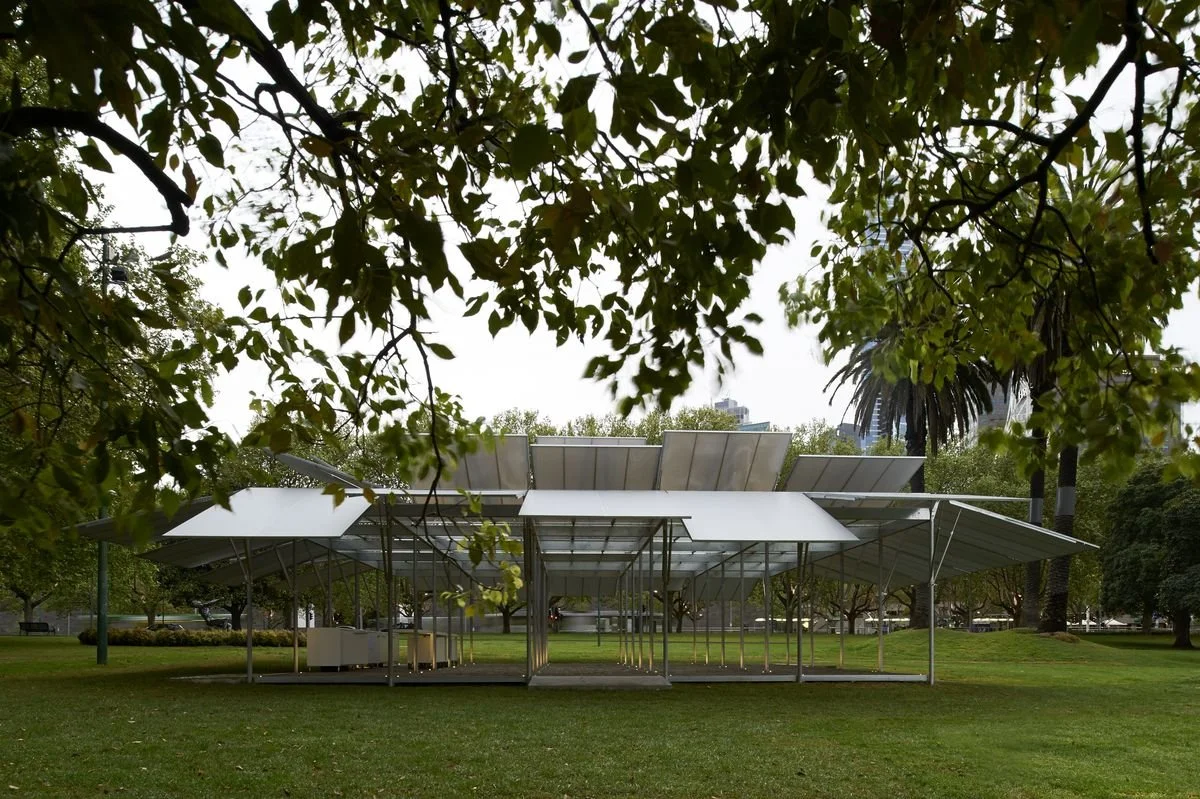
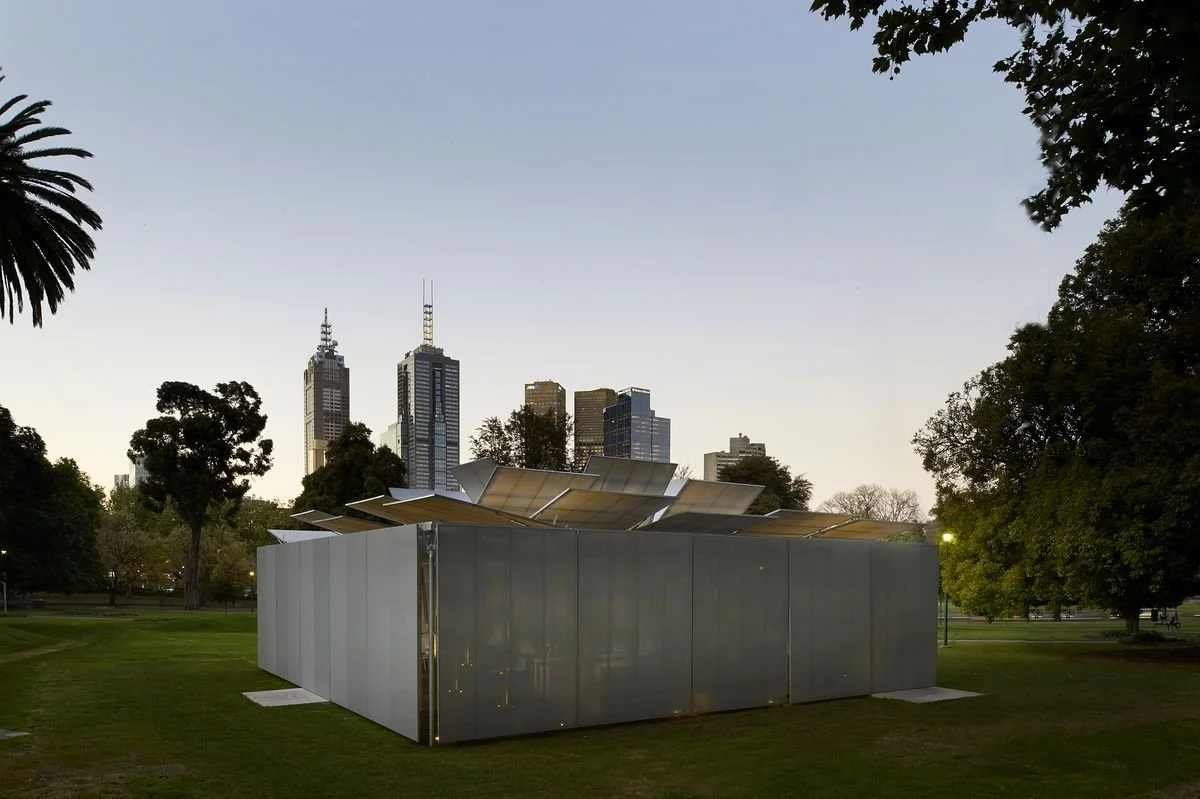
It would only be years later and attending various conversations and presentations by Sean that I would realise that the Pavilion holds nods to Godsell’s previous works. The movable panels, function like a ‘blooming flower’. This designed movement is a constant motif in Godsell’s works, as seen in House on the Coast or House in the Hills – the hero images also depict the architecture with the large silver panels glistening in the sun. Internally, the piloties used in the floor plan of the pavilion – is a nod to Corbusier’s ‘5 points of architecture’ the audience a glimpse to his grid-like and geometric design (and dare I say, my favourite Godsell Reference – Green House and Alice Through The Looking Glass). The combination is simple and clean cut, and when looking from different angles, the pavilion almost reminds me of an automaton trying to adapt to its surrounds. What appears to be a simple tectonic really is a system of detailed documentation that unveils a clean architecture – and one I feel that compliments Glenn Murcutt’s eventual MPavilion (which happens to be my other favourite).
One thing that made MPavilion rather successful is the relocatability of the pavilion. Where the pavilion is now is a lovely pavilion by the Hellenic Museum. However, while the structure sits poetically at the current venue – Sean Godsell has recently announced that it may no longer be a home to the location. Given the nature of the structure and purpose itself, I can think of several locations that the pavilion may sit.
1. Monash University – Caulfield Campus
It’s been a few years since I’ve entered my campus, but I can think of the pockets of space created by KTA and TCL. Should the pavilion have the ability to section and divide itself, we can have mini pavilions disbursed around the campus – plus it compliments the metal perforated facades on the buildings
2. Botanical Gardens
I’ve seen marquees being set up at the Royal Botanical Gardens for weddings and events, but imagine having the structure there? That would be a perfect opportunity for guests to take shelter while having the open air during a ceremony and reception.
3. The Fox: NGV Contemporary
I’m going to leave it here for imagination. Concrete and steel would be a lovely combination no?
4. A shelter for someone?
Given the Pavilion almost resembles a house and has adopted free-planning. I can foresee the Pavilion becoming a home or a shelter for someone. Understanding Godsell has designed architecture for the displaced (re: the outdoor bench that turns into a bed), if the architecture is repurposed into an inviting architecture – perhaps the pavilion would have another profound purpose. I also want to stress given that the model of the pavilion is a ‘pre-fabricated award winning building’ - surely it could be a model that we can study for future pre-fabricated homes. Can it be further developed into something that offers a place of permanence or safety for someone / family in need? This has happened with a studio project I worked on in the past - so I can imagine this could also be repurposed into something else - if not, learn from its prefabrication structure.
It will be interesting to see where the architecture will go – because it will be a great shame should we let a catalyst of something so wonderful to disappear.
Especially when there is so much potential for it to develop further.
This entry was written while the moon dances across Wurundjeri Land
Reference:
Frearson, Amy “Sean Godsell unveils inaugural MPavilion in Melbourne’s Queen Victoria Gardens'“, Dezeen, 14 October, 2014. https://www.dezeen.com/2014/10/07/mpavilion-sean-godsell-pavilion-melbourne-queen-victoria-gardens/